

for best workplace performance, the oscar goes to...: timothée chalamet, visibility culture, and the resurgence of chalance
"Visibility went from just one method of climbing the corporate ladder to possibly the only way to stay on it."


[editor’s note: I’m aware Timmy is not Gen Z (he is 29, so close), but I do think his speech embodies a Gen Z attitude! You don’t need to be Gen Z to exude the aura!!]
In the first-ever ‘for breakfast’ podcast, I spoke about Charli XCX’s Vulture feature from October of last year. In it, she plays coy about her desire to win a Grammy:
I’m not assuming I’ll win a Grammy. I need that to be in print,” she says after our food arrives and talk turns to what she would do onstage if she did (she wouldn’t say). “Do you think I will win a Grammy?” Charli asks. I tell her I don’t pretend to know how those sorts of things work. She shovels a spoonful of a rice bowl into her mouth and reframes it: “Do you think I should be nominated for a Grammy?”
She doesn’t care, she tells me several times, about what she considers the old rules of pop stardom: streaming (except her Spotify numbers are pretty solid), magazine profiles (like this one), talk-show appearances (she was on Seth Meyers with Sivan in April), or awards. But she “wouldn’t mind” a Grammy, she admits.
While I declared that I don’t think an artist can “not care” their way to Grammys, I’m not surprised that Charli ended up bagging a few.
It’s one thing to try hard, and it’s another to talk about how hard you try and the things you deserve or desire as a result. Charli keeps up her brat era in exemplifying the status quo for public figures of the last few decades. That status quo is duck syndrome. It’s shut up and dribble, it’s smile and wave, and it’s nonchalance.
Charli actually tries very hard, and she has for the entirety of her career. We can look to her pop star peers who also won big last year and at the Grammys ceremony. The narrative? Overnight success isn’t so overnight. Doechii, Sabrina Carpenter, and Chappell Roan also embody this trope.
People are catching on:
Kaysha writes:

We have video essays:
F1 royalty and my #1 pookie, Lewis Hamilton says:
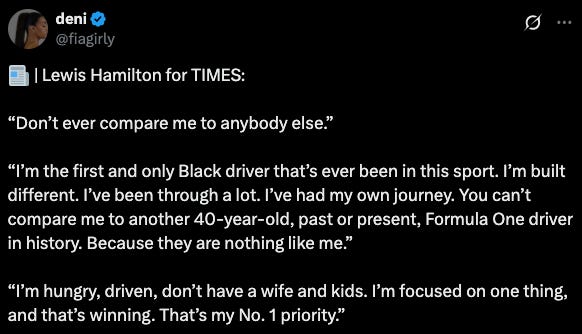
Maybe it is now the cool thing to try hard.
Timothée Chalamet has been on a losing streak for most of his career, something even he poked fun at during his recent SNL appearance. In January, the actor did double duty as host and musical guest, ending the episode with several earnest renditions of his favorite Bob Dylan deep cuts.
Chalamet’s whole award campaign for his performance as the folk singer in James Mangold’s A Complete Unknown was the epitome of trying hard. College Game Day for the boys. Camp fashion tributes for the gays. A Theo Von podcast appearance for the conservatives. A Brittany Broski interview for their liberal girlfriends.
After losing most major acting awards to Adrien Brody for his role in The Brutalist, Timothée needed a win to hopefully change the tide before the Oscars and he got it. When accepting his SAG Award for Outstanding Performance by a Male Actor in a Leading Role Award (when did award titles get so long?), Timothée delivered what then became his last public address during awards season:
I know the classiest thing would be to downplay the effort that went into this role and how much this means to me. But the truth is, this was five and a half years of my life…
And lastly, I can't downplay the significance of this award. Cause it means the most to me. And I know we’re in a subjective business, but the truth is, I’m really in pursuit of greatness. I know people don’t usually talk like that, but I want to be one of the greats. I’m inspired by the greats. I’m inspired by the greats here tonight. I’m as inspired by Daniel Day-Lewis, Marlon Brando, and Viola Davis as I am by Michael Jordan, Michael Phelps, and I want to be up there. So I’m deeply grateful. This doesn’t signify that, but it’s a little more fuel. It’s a little more ammo to keep going. Thank you so much.
If you’re anything like me (or, as of this week, Viola Davis), you found Chalamet’s speech gracious and refreshing amid what felt like one of the longest Oscars season in recent memory. On the other hand, certain corners found the speech divisive: Vogue ponders “Was Timothée Chalamet’s SAG Award Speech Endearingly Honest or Manosphere-Enabled Overconfidence?”
While the reception to Timothée’s speech leans positive, there is still a generational divide of what can be deemed tasteful or not to express in the public eye. Timothée takes things one step further than most: He name checks the greats, he acknowledges how hard he as worked, and even states plainly what he and his peers quietly know to be true: that a SAG award is just a step to the real thing, an Oscar. Call it gauche, but it’s hard to argue he’s wrong.
In a cultural moment controlled by the maligned and ill-defined Gen Z, his speech was a well-calculated move bound to go over well. If anything, Chalamet’s subsequent loss to his bumbling, rambling peer helps his case. He made a public declaration of his work ethic and ambition, and we all got to see him humbled in the face of it. It’s smart, because even though Timothée doesn’t have the award he was gunning for, he’s shown himself to be comfortable and aware in an industry where those traits are hard to exude.
On the other hand, you could say an actor like Timothée (white, male, young, French) was poised for success long before and regardless of what he had to say on the SAG stage. I spoke about this last summer as we witnessed Glen Powell’s bid for a more American kind of this movie stardom:
Zendaya and Glen Powell both work hard, but only one of them really gets to talk about it—constantly. I feel overly familiar with how scared Glen Powell was of not "making it." That talk track is reserved for the whitest and brightest it seems.

While Chalamet’s speech may not be the best litmus test for what we require to start respecting our movie stars, it may be a good marker for where we’re moving in a broader pop culture.
Chalamet was nominated for his first Oscar at 22-years-old for his performance in Call Me by Your Name (2017). Since then, he has led a top-grossing franchise, been in a collective seven Best Picture nominees, and remained generally likable, brand-safe, and consistently compelling after nearly 10 years in the public eye.
If Timothée Chalamet, a generational talent and beloved inside and outside his industry, can’t claim his hard work and track record of success without some sort of backlash, it makes sense that those his age and younger ask: who among us can?
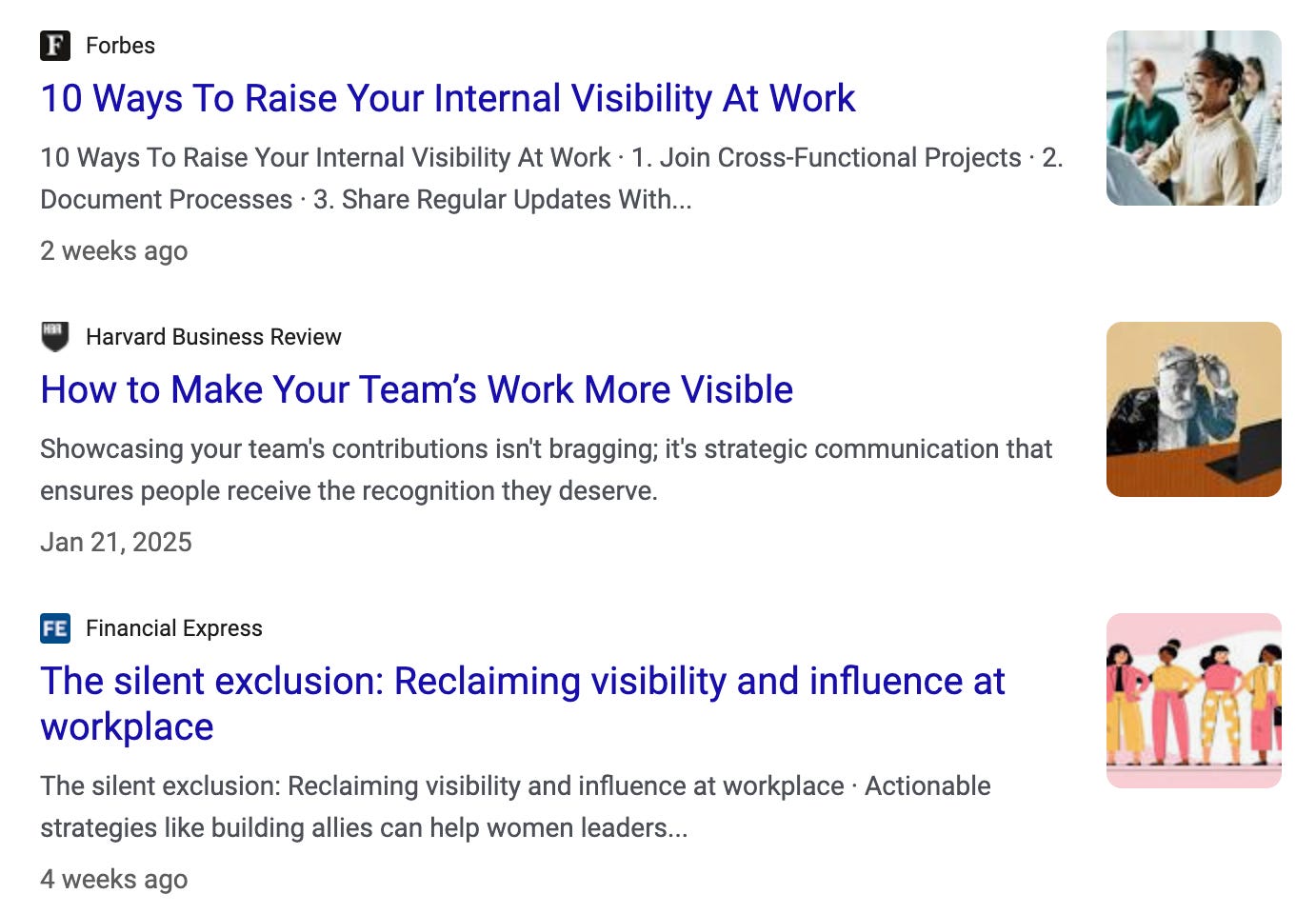
If you’ve held a corporate job or applied for one in the past few years, you may have noticed this idea of “visibility” popping up over and over.
You come to an office, you do all the work you’re assigned and more, and then your manager pulls you into a meeting about how to make that work — the work you talk about ad nauseam every day — more “visible” than it already is. It’s the corporate equivalent of keeping up appearances, and it’s another form of invisible labor that in some organizational structures can eclipse the work itself.
You need to send Elon five bullet points about your government job to prove the job exists or has value. On your resume you need to make up percentages to prove your underpaid presence made a difference or had “impact.”
As the language of visibility rises in the workplace, we also the see the slow and fervent backlash to our 2020 racial reckoning and with it the rise of DEI policies as well. Post-Trump a switch has flipped and visibility went from just one method of climbing the corporate ladder to possibly the only way to stay on it.
Most of Gen Z, young Americans in general, have known nothing different than a punishing ,crazy-making work culture once they leave or even while they experience their secondary or higher education. The hellish job market, LinkedInfluencing, rising tuition costs, layoff brain, unpaid internships, and no guarantee of affordable housing even while you’re employed full-time — all add up to working hard no longer leading to playing hard.
Talk about numbers and impact? Timothée Chalamet’s face can draw hundred of millions of dollars in a recessing global box office. If we turn up our noses at the most visible, one of the most hard-working of his profession, a Timothée Chalamet, then that has bleak implications for what the average person would have to do to feel they’ve earned their place at work and are allowed to express that, especially if they’re already marginalized!
Even though we get called whiny, it is still quintessential Gen Z to refuse to grin and bear it when it comes to the workplace. Young users’ tend to gloat and flex online, because digital validation is a consolation prize for all the economic precarity despite one’s hard work.
When working is punishment, it makes sense that young people don’t want to be punished for acknowledging that. Lucky for Chalamet, it’s clear most of us don’t even want to do the punishing anymore.
let’s not forget the song of the blog:
Sad to be missing DJOchella this weekend because the album is great!
My only Bob Dylan reference is A Complete Unknown - but the intro to this song feels sooo Bob Dylan to me. Real Dylan-heads feel free to check me tho.
here to give more love to “Egg”! Djo’s album is truly so great! 😩
Your points are top notch!!!, especially, visibility at work, yep it's a thing and TC's acceptance at the SAGs, I loved it, and was happier when I read Viola's response. Keep going 👏🏽👏🏽