

what's so funny about obsession?
the cheap thrills of curry barker’s diet horror

There were very few laughs at my screening of Obsession. I left the theatre, wrote a glib one-liner review about “women in male-dominated fields,” and moved on with my day. Later, after some scrolling and a quick review of the podcast circuit, I deleted my review out of paranoia that I’d failed some sort of test. While I spent the last hour of the film waiting for the incel to off himself, maybe I hadn’t spent enough time contemplating the interiority of one possessed young woman in a headband while she attempts to murder, terrify, or embarrass him — all against her will, of course.
Curry Barker’s 109-minute, $750,000 trauma thriller follows Bear (Michael Johnston), a boring young man who makes a wish (accidentally, through way of branded stick toy) that his work crush, Nikki (Inde Navarrette), will “love him more than anyone else in the entire world.” What I found attractive about Obsession is that it actually has its moments where it resembles a good horror movie. Though the film has all of the narrative engine power of an episode of SpongeBob or The Regular Show, a classic be careful what you wish for/phrase your one wish correctly tale, it is successful enough to elicit dread consistently.
When I made up my mind about Obsession a few days later, I landed on 2.5/5 stars. Continuing to stew over the month, I think it hurt my ego that I might’ve been intellectually bested by #bitchesbelike the movie. It hurt more when I had to read infographics about how it passed Sinners at the box office. It drove me over the edge to hear the words “Oscar” and “buzz” for a movie that I was beginning to suspect was just below okay.
Maybe Obsession is so seductive because it picks up one of the hottest cultural topics right now, abuse in straight dating and relationships! The movie fails to get its hands dirty, though, demonstrated by how flat the scare mechanisms are and how much the film relies on Nikki’s humiliations and abuses of Bear to disturb.
So much of the movie is shocked, static faces from Bear and blank stares from partygoers with all the agency of dormant Sims, bearing witness react-video-style to Nikki acting out. I’m all for extended metaphor about the isolation of an abusive relationship, but in its lo-fi, haze, and preoccupation with its protagonist, Obsession isn’t exact enough for a coherent narrative about its subject matter to make it out alive.
Is it about love and mutual abuse? Is it about how we should say how we feel, lest our projections turn us evil? Is it about an evil man who creates a sex bot that (accidentally) turns evil as a result?1 I think I could respect a movie where the answer to all of these questions was yes, but what’s surprising about Obsession is you can’t make the case, fully, for any of these readings. Every allegory is there but not quite. Every metaphor contradicts itself later. Nikki is cartoonishly evil, except for the two scenes where she suddenly stops. The rest of the time you must squint hard and think about the word “victim” over and over.
The scares, the only real points of emotionality and entertainment, rely on depictions of intimate partner violence from played straight (coercion, raised voices) to over the top (dead cat feeding, murder, skin-wearing). If the One Wish Willow is, say, a manifestation of Bear’s darkest desires (Nikki as sex doll), the function of the scares, again, relies on Bear’s displeasure, discomfort, and danger, not Nikki’s. They are both losers (victims, maybe), but the majority of the film’s scares have us feel for Bear at the hands of Nikki. Acknowledging her victimhood is optional, and most of the time the movie asks you not to, hence the laughter. Obsession is very much the “Don’t you hate it when your batshit crazy stupid psychotic girlfriend shits on your floor :(” movie, not a “Don’t you hate it when you get possessed by the sex demon that makes you shit on your boyfriend’s floor :(” movie.
Though some will say the film features just enough pre-wish Nikki for us to fake concern for her and her ruined writing career, Obsession fails to interrogate her true in-theatre, on-page story function as a villain for the other hour of the runtime. In a roundabout way, the film’s logic and Barker’s centering of Bear telegraph that the worst-case scenario for a man’s misguided desire is him experiencing all the pain, and she just happens to be there.
If your theatre was lucky, Obsession played to frequent and fervent laughter. For as widely seen as the film is, I’d be remiss to chalk all of those laughs up to discomfort. As much as I see it called a horror, I also see Obsession billed as a black comedy or twisted rom-com. For the first time, I will ask what exactly is so funny?
Tonally, Obsession distances itself from its black hole of a protagonist (because he’s evil, boring, and deserves it), but points and laughs at its victim (because Nikki’s horrors are where it’s time to keep it light, of course). It also relies on you imagining an alternate reality where Bear shared his feelings with Nikki, and things went fine, but at the same time you must also imagine Bear evil enough, subhuman enough, to not deserve a love in the first place.
Early on, the case could be made for Nikki as manic-pixie-dream girl whom Bear covets, not loves. However, since the film plays so fast and loose about the complications of relationships where love and abuse coincide, by its gruesome end the film is open-ended enough to imply that abuse — obsession — is actually on the spectrum of love, just a crush gone too far. The verbiage of Bear’s wish adds to the ambiguity.
Barker is interested in Bear’s capture, Bear’s punishment, but not what it’s like for Nikki to be a captive. If you’d like to call Nikki up and ask her how she’s feeling, you’ll be met with anonymous screams and a customer service representative who thinks it’s all very funny too.
Obsession is about an “evil” guy getting what he “deserves,” and that “justice” must be sublimated through a possessed woman first for reasons the text can’t explain. If Obsession needs you to laugh to make sense, but those laughs are at the expense of the female character, that makes the film “deep” and this specific vector of violent imagery justified; no one actually has to hold the bag for why it’s Nikki, and then Sarah (Megan Lawless), who have to suffer for Bear’s failures. Ha. Ha.
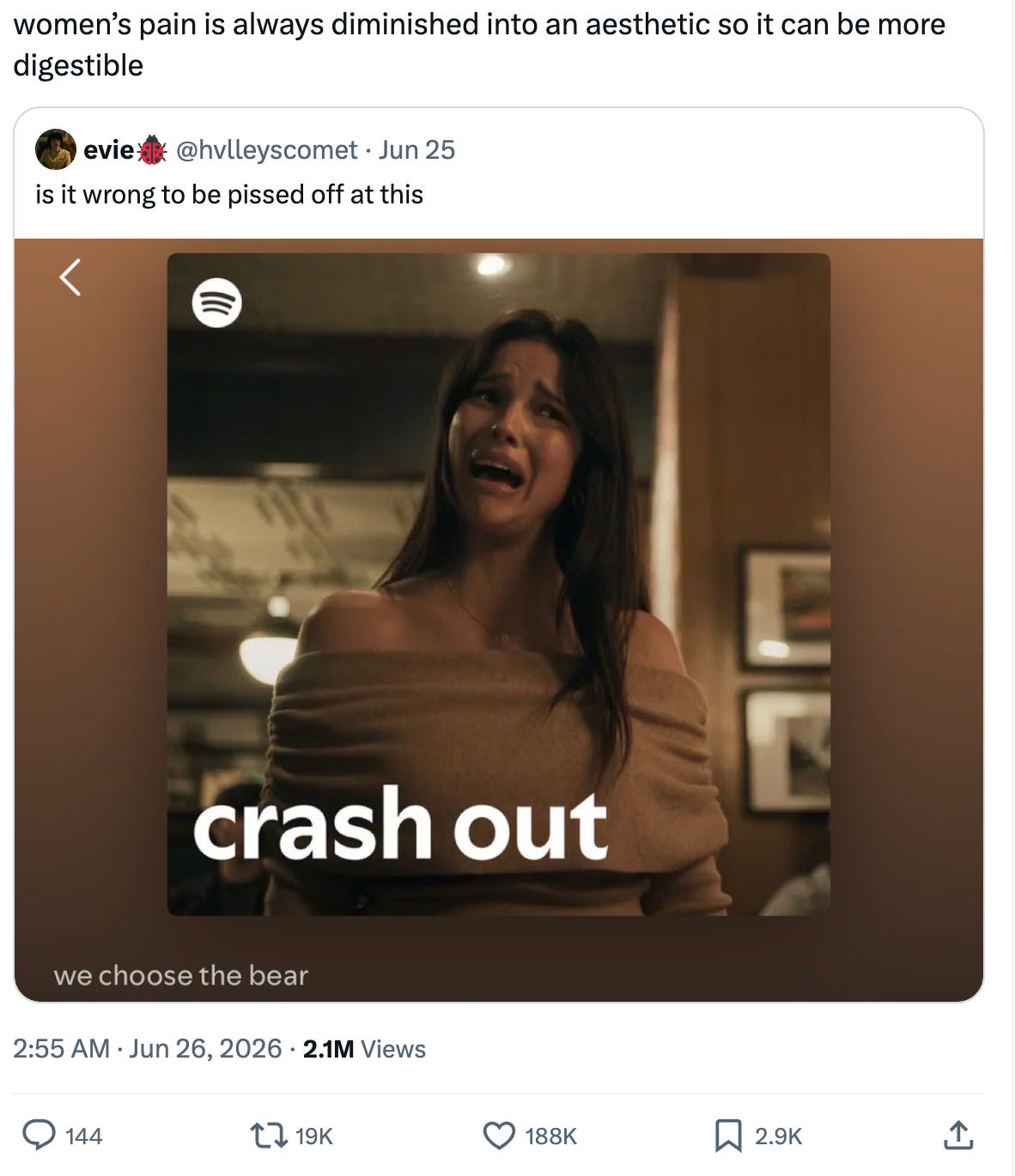
Barker also plays coy about his protagonist’s evils and pleasures at the expense of any dramatic tension around the fate of these two victims/perpetrators. In place of that tension, you get the opaque, convenient whims of the One Wish Willow. When Bear refuses to put Nikki out of her sometimes-apparent misery, it doesn’t feel like anything because the movie is already on Bear’s side in treating her like she’s dead. Post-wish, Nikki mostly superhuman and vacant, it quickly becomes clear there is no way out.
The merits of Obsession seem unrelated to some buried deep read about mutual abuse that everyone is able to pick up on and laugh over. Maybe this film is just highly successful in replicating and energizing images of intimate partner violence with such fidelity and with just enough plot to distract. However, for a society literate in abuse imagery in the short-form, Obsession’s scares are low-hanging fruit. A somatic, experiential exercise in trauma that no one, even me, wants to admit they get off on.
So much of what gets me to write criticism is a need to address not a thing but how we talk about a thing, but I think there’s a lot to learn about what a movie does by what people say about it. For a movie that has made nearly half a billion dollars, I’m observing more than the usual amount of confusion among viewers. The people who hate Obsession feel like they’re missing something, but those who adore it, identify with it, the young women who feel represented by Nikki — but don’t want to demand that even a fictional woman deserves better — keep begging you not to look into it too deeply. That is funny.
As for its popularity, the confusion, the controversy even, surrounding Obsession is written into it. A fragmented online collective blames themselves or one another for reading it wrong, drumming up engagement while projecting whatever they need to feel good about themselves. And who can blame them? It is strange to me, though, that Obsession’s defenders rely on the language of victimhood, abuse, manipulation, coercion, rape, etc. to justify the sidelining of Nikki and to make the case for Bear as the villain but reserve no space for feminism in that same conversation. We watch a different young woman, Sarah, get her head bashed in for what are ostensibly the same thoughtcrimes as the protagonist, yet the very framework that has us look inward about why we actually find that imagery, this whole farce, frightening has been treated as off limits as a way to point out the film’s shortcomings.
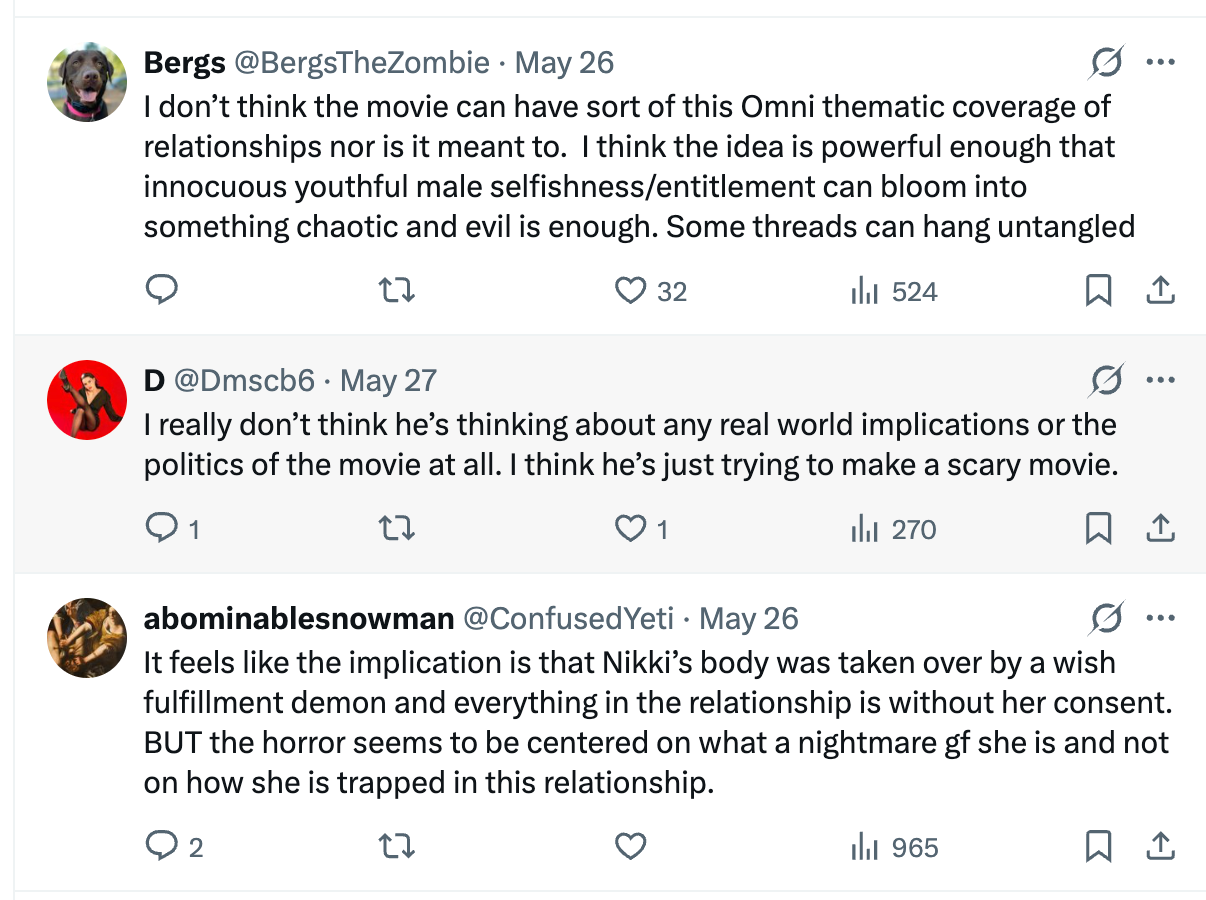
The most damning thing about Obsession is that so many people really like it. Or did we suddenly wake up in the timeline where general audiences react well and normally to stories about women’s abuse at the hands of men? The same culture that had a lot to say about a woman “suffering” at the “hands of a man” last summer? A good horror movie, as opposed to the wishy-washy thriller of Obsession, wouldn’t be shy about Bear’s evils, but Barker works around them so no men have to ask if they are Bear; they just have to ask themselves if they could come up with a better wish.
What we’re left with is a kind of diet horror that feels good going down, like some emotional work is being done, but ultimately lacks anything substantive. Obsession asks you to think very small about some of the biggest issues plaguing our time, and it’s not rigorous or fastidious enough in its logic to understand why it is able to amuse and scare and that those interests contradict and undermine any messages it pretends to have. It’s sloppy. Anything gruesome is “gritty” and “real,” anything goofy is “satirical” and “knowing,” but the film doesn’t operate at any level deft enough to entertain while also having Nikki, the character, transcend the headband and dead-wife-in-a-movie edits post-mortem. The film is unable or unwilling to alienate, so it coddles by being vague.
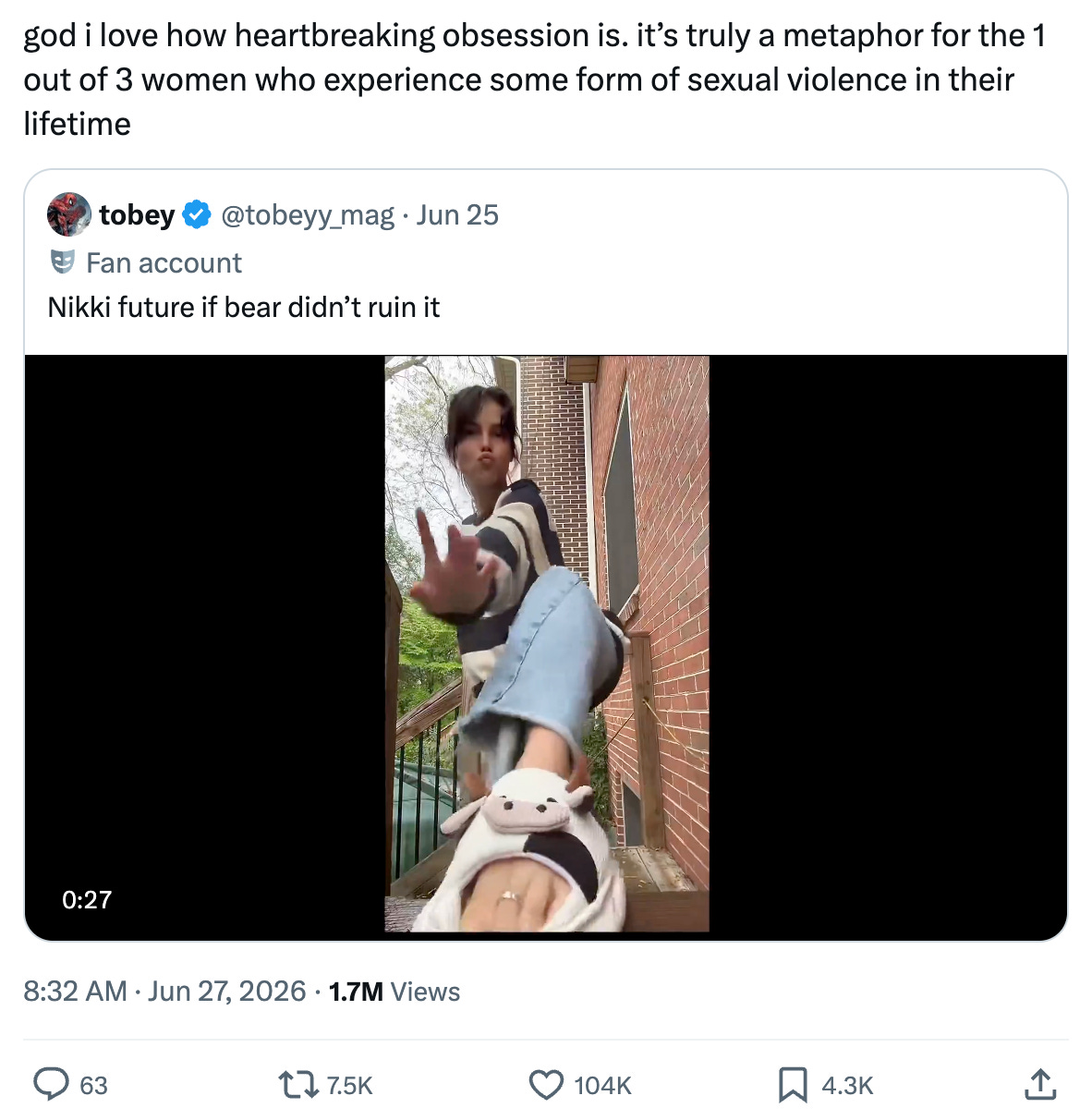
It is my hope that every year, many movies, stupid or not, make a lot of money so that more movies get made. I also have a great affection for movies that waste hours of your life for not making sense or fully coming together. I have publicly defended Poor Things, and I’d defend Promising Young Woman in the right company. I’m plenty generous, but just because Obsession can be read “generously” as a cultural artifact does not mean it should be. There also are tons of effective films that cost much less than $750,000 and make perfect sense.
Critically, though, I fear there has been a softer response to Obsession and how it handles the abuse and trauma of women in favor of lighter, tangentially related conversations about Gen Z and dating or being a white YouTuber who loves horror. Or, when all else fails, we can just talk about Backrooms instead! My only guess2 as to why is that it’s a tough pill to swallow that the movie to save movies this year, the movie with more upside than anyone knows what to do with, the one that checks marketers’ and audiences’ boxes alike is, at its core, kind of basic and hollow.
This critical softness may also demonstrate how film fans, even those whose job it is to be critical, feel a compulsion to make the general case for film, the medium, in their day-to-day lives now that everyone is more aware than they were a decade ago of theatre margins, box offices, and the woes of investors’ risk. The institutional urge to celebrate the underdog film where most of its underdogs didn’t get paid for the film’s wild successes… that is also kind of funny, I guess.
At Obsession’s end, I remember thinking of Romeo & Juliet, suicidal ill-fated lovers and whatnot. I can choose to think it was on purpose or convince myself this film has anything substantial on its mind, or I can choose to know better. You leave feeling empty for a reason. This crisis of horror is really quite modern: the film is stuffed with gestures and signs that lead nowhere except a sequel that will surely answer any questions or concerns I have about the antics going on at OWWLLC and the other young women they have trapped in the basement.
When awards season rolls around and you see the words “snubbed” next to Barker or Navarette’s names (sorry, Michael, it’s just what Twitter thinks), I don’t want that to be a bad thing. Maybe a sign that the Academy doesn’t have an abundance of avenues to acknowledge rising talent or more commercial endeavors, yes, but not a sign of the Academy’s inability to reward movies people actually watch and like, even when they suck. [I’m sure Project Hail Mary will fail upwards enough.]
Despite its modest upbringings, Obsession doesn’t need awards or for you to think it is “deep” to justify its place in our culture — that’s what the money was for.
Not a serious movie! So, let’s be serious people.
song of the blog:
let’s talk about something that is extremely popular, but actually extremely good. “the cure” (+this whole album) begs the question, isn’t love scary enough?
i loved this discussion of olivia’s face on the cover! is she in ecstasy? pain? it’s all very the bends. she embraces the contradiction and ambiguity to great success and leaves you with more answers than questions. i’m feeling a strong 10!
shoutout Companion (2025) though! (4/5 stars)
besides the shuttering of feminist publications over the last decade :/
love this because i fell into the camp of feeling nothing but contempt for bear (his kind of lame/pathetic evil) and horror/despair for nikki especially with how she's left at the end - and i had supposed this was the basic/intended read of the movie, so i liked it and some of its stylings. but then i was similarly perturbed, a bit confused, and ultimately dismissive of the marketing and a lot of responses that were like "haha she's sooo crazy" and that's why this movie is a hoot! like huh? really appreciate your focus on the film's mechanisms and framings that really set up and rely upon this latter reading of it and how murky it makes its execution and reception...including mine lol thinking about what/how much i maybe was projecting onto it?? an eternal question
I'm so happy to finally read a piece about this because it's all I could think about when I saw it. The marketing campaign also heavily deployed the "isn't a crazy obsessive girlfriend funny?" angle, I understand why, but it didn't help people's read on the story and I'm sure caused many to not look beneath the surface of it.